Safety and CTA identity
Only normal-tissue risk evidence can make a protein Unsafe. CTA admission also requires cancer expression, Reproductive evidence and adequate coverage.
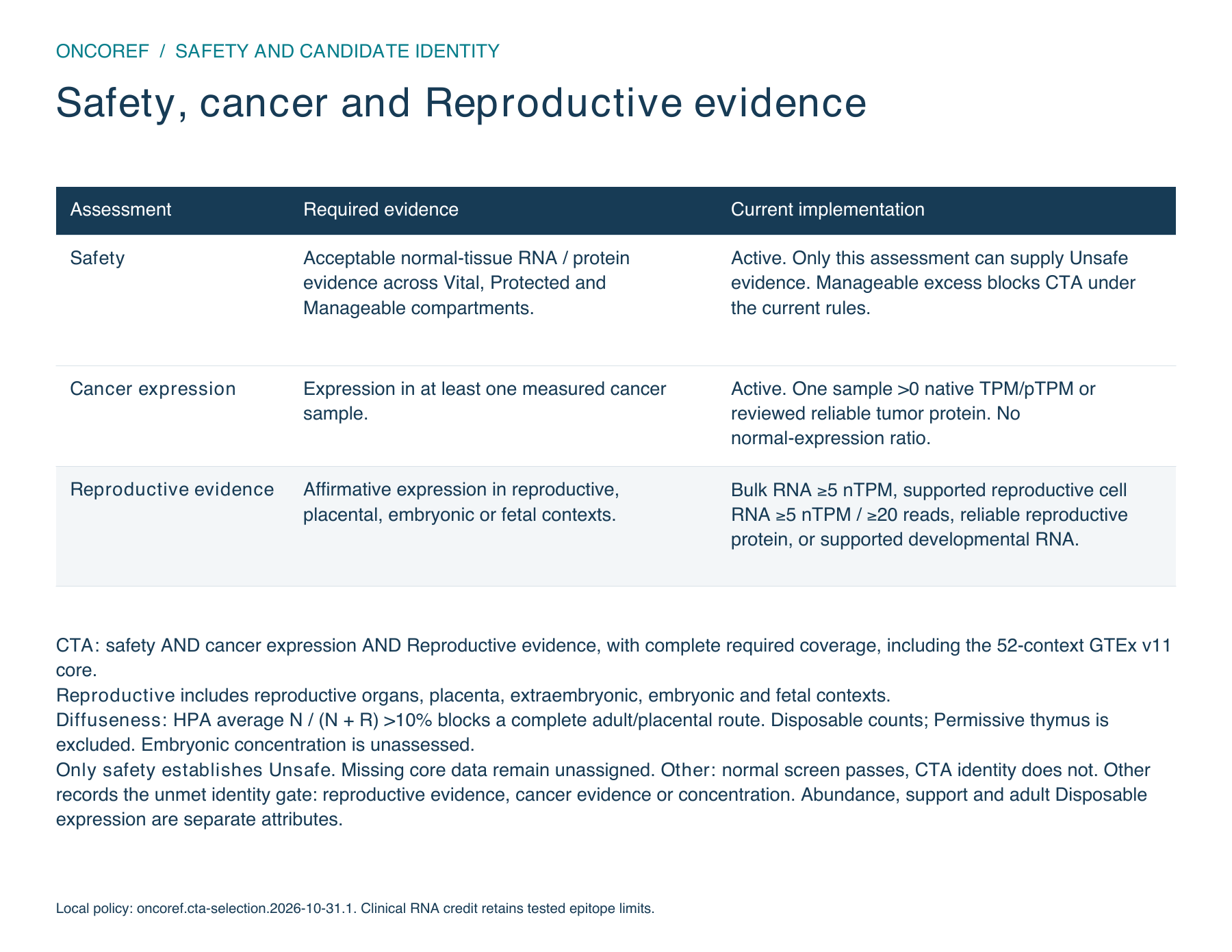
One-page PDF · Actual thresholds
Current decision logic
Qualifying normal-tissue or applicable clinical safety exclusion -> Unsafe

Acceptable safety AND one qualifying cancer sample
AND a qualifying Reproductive route after concentration assessment
AND complete required coverage -> CTA

Otherwise: complete normal screen passes -> one named Other category
Remaining missing normal evidence or normal-screen holds -> Unassessed
Reproductive means reproductive, placental, extraembryonic, embryonic and fetal. Named branches retain anatomical and developmental precision. The current measured routes are full mapped HPA reproductive bulk RNA ≥5 nTPM, supported reproductive cell RNA ≥5 nTPM with ≥20 reads, reliable positive reproductive IHC, or supported Tyser/Petropoulos embryonic lineage mean ≥5 TPM (≥20 cells, ≥5 positive cells, ≥10% positive at ≥1 TPM). The current inputs do not cover every fetal stage.
Cancer requires one sample >0 TPM or HPA pTPM, or reviewed reliable tumor protein, without a normal-expression ratio. This establishes qualifying RNA, not necessarily translated protein, presentation or expression in a specified fraction of patients.
Required coverage includes the fixed GTEx v11 52-context bulk panel, every member locus, plus the existing normal bulk/cell/immune panels. Optional DICE/cornea absence does not block admission; observed counterevidence still counts. A missing measurement never becomes zero.
Safety remains an independent assessment
Vital/Protected above-ceiling RNA or qualifying protein evidence can establish Unsafe. Manageable excess blocks CTA without automatically establishing Unsafe. Negative IHC adjusts the RNA ceiling only with the required antibody and local-cell coverage. Missing or unrelated staining is not negative evidence. The exact numeric rules remain in the current policy table.
Reviewed TCR-T clinical experience can add one RNA ladder step, capped at the Enhanced-negative ceiling. It does not change the IHC grade or any cancer, Reproductive, coverage or diffuseness criterion. The exact epitope/HLA/product limitations and serious-event attribution remain attached to the protein-level credit. Clinical evidence and SAE review.
Profile concentration
The old rule requiring a Reproductive value above the highest normal measurement
has been removed. A single normal outlier should not define whether a protein is
diffuse. The score averages N / (N + R) over a fixed anatomy-weighted
normal panel, including Disposable tissues. N is that tissue's RNA; R is the source's
Reproductive reference. It is not a percentage of tissues.
The HPA v23 >10% boundary is active for completely measured adult/placental profiles with a positive RNA reference and a qualifying RNA or IHC association. RNA-only association still requires 5 nTPM. A zero RNA reference leaves concentration unassessed even when IHC qualifies. Disposable tissues count; Permissive thymus is excluded from both the comparator and the reference. The fixed panel is 38 contexts / 29 anatomy units. A failed route with no other qualifying Reproductive route and clear safety becomes Other:Diffuse. MTCP1 is one example (24.53%). Independent Unsafe assignments do not change.
A weak adult reference does not decide embryonic identity. Supported embryonic routes remain eligible with concentration explicitly unassessed until compatible developmental/adult data exist. Missing HPA comparisons remain unassessed; the GTEx core remains mandatory. Method and measured impacts.
MAGE-A4, NY-ESO-1, PRAME, CTAG2 and XAGE1A/B retain CTA classification and GTEx coverage. Removing the old maximum veto alone would admit TGIF2-RAB5IF and ATF7-NPFF; both lack the required GTEx core and remain unassigned for that explicit reason.
All entries called Proteins collapse identical selected reference sequences; originating loci remain listed. This is not a catalog of every alternative isoform or modified proteoform. Human measurements and thresholds do not transfer to dog or mouse through orthology.
Other reasons and independent attributes
| Other reason | Proteins | Meaning |
|---|---|---|
| Nonreproductive | 448 | No qualifying reproductive / placental / embryonic-fetal presence |
| Reproductive | 0 | Reproductive presence qualifies; cancer presence does not |
| Diffuse | 5 | Both presence requirements pass; reproductive concentration fails |
Normal abundance, tumor support and adult Disposable expression are separate
attributes in cta_selection.profiles(). Disposable is an adult tissue designation;
embryonic/fetal/placental measurements do not change it. The 2-unit descriptive
floor is not a safety ceiling. Simple funnel and four example proteins.