Historical literature-inclusive CTA and oncofetal catalogue
The 447-gene quantitative proposal supersedes this catalogue for the requested uniform shortlist. This historical view retains its literature admission routes for comparison.
1,416 biological candidate genes, after reprocessing all 20,097 canonical
human genes. PRAME, MAGE-A4 and NY-ESO-1 (CTAG1A/B) pass the established-evidence
route, independently of normal-expression concerns. Policy:
oncoref.cta-membership.2026-10-26.2.
Complete selected list · Every gene · Changes from 215 · Control results · Reviewed primary evidence.
Revision 2 removes non-MAGEA4 MAGE genes from positive controls and automatic reviewed admission. CT83, SSX2 and TBXT are explicitly user-required controls. Named genes and admission routes · Unsafe/Neither counts · Every nonselection reason.
This set answers whether a gene has a reproductive/developmental association and cancer evidence worth retaining. It is a broader biological catalogue than the earlier expression/clinical shortlist. It does not certify normal-tissue absence, peptide presentation, a targeting product, or clinical safety.
The rules on one slide
Resolve the human gene identity; admit through any of three routes; keep normal-expression risk and evidence gaps alongside membership.
| Admission route | Common rule | Selected tier |
|---|---|---|
| Established biological evidence | Reviewed primary evidence links the resolved gene/shared antigen to reproductive or developmental biology and cancer. Clinical response is supportive, not mandatory. Normal expression does not revoke biological identity. | 15 |
| Publication consensus | At least 2 distinct publications nominate the gene as cancer-germline or cancer-placental. Multiple tables of one DOI count once. Normal-only enrichment papers and mixed antigen panels do not count. | 1,053 |
| Expression-supported candidate | Reproductive RNA ≥1 nTPM and ≥4× the maximum comparator-tissue RNA, plus published or measured tumor expression. Core scope is testis/ovary/placenta; other reproductive organs additionally require a cancer/reproductive publication. | 348 |
Tiers use this precedence and sum to 1,416; qualifying routes can overlap. Expression-supported candidates need complete measurements across the named HPA bulk panel. A measured zero can be used; missing values cannot. Core enrichment compares three tissues against the other 47; extended reproductive enrichment compares the eight additional reproductive tissues against 39 nonreproductive tissues. The named panel is not exhaustive normal-cell coverage.
Measured tumor support means ≥1 pTPM in ≥3 samples and ≥5% of one cancer/cohort, or ≥2 Medium/High IHC cases in one tumor group. Counts are not pooled across cancers or TCGA/validation cohorts. Published tumor support comes only from the explicit cancer/reproductive source roles. Native pTPM and nTPM are never compared numerically. IHC expression support is not independent validation of every antibody.
The old reproductive admission floor was 5 nTPM or alternative protein/reviewed evidence. The new expression-candidate floor is 1 nTPM. Established membership and publication consensus no longer depend on a modern atlas reproducing every rare reproductive cell state or tumor context in the literature. Adult RNA ceilings, IHC quality, donor variability and cell-RNA thresholds remain risk annotations instead of deleting established biological members.
What changed from 215
213 retained + 1,203 added = 1,416. Two previous entries, SPATA31A1 and SPATA31D3, are unselected: the imported evidence supplies normal testis bias but neither a qualifying cancer/reproductive publication nor current tumor support. This is insufficient evidence, not proof they cannot be expressed in cancer. Of the new set, 105 genes were outside the prior 2,540-gene nomination universe.
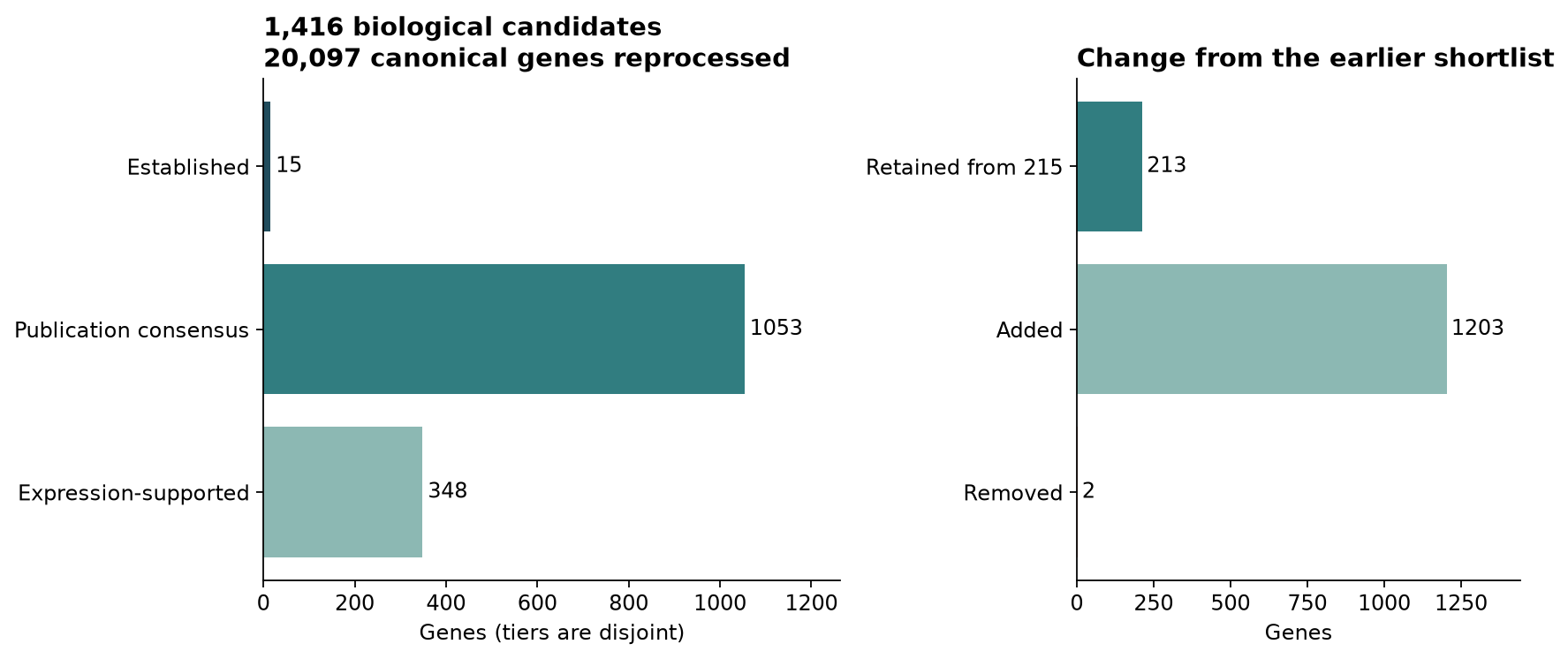
The classes are nonexclusive: 1,324 cancer-germline, 71 cancer-placental, 74 other cancer-reproductive, and 5 reviewed oncofetal genes. The umbrella is explicitly broader than strict cancer-testis antigens; a lineage annotation does not automatically make every member a validated immunologic antigen.
Positive controls and interpretation
| Group | Controls retained |
|---|---|
| User-required | PRAME, MAGEA4, CTAG1A, CTAG1B, SSX2, CT83/KK-LC-1, TBXT/brachyury |
| Additional established CTA controls | CTAG2/LAGE-1, SYCP1 |
| Cancer-placental controls | VGLL1, PLAC1 |
| Additional oncofetal/developmental controls | AFP, GPC3, SALL4, CLDN6 |
MAGE-A4 is the only MAGE positive control. MAGEA1, MAGEA3, MAGEA6, MAGEA10, MAGEC1 and MAGEC2 now have context-only review records and no automatic reviewed admission. Each remains selected organically through 5–7 distinct cancer-germline publications. They are not negative controls either. Their primary citations, toxicity caveats and normal-expression flags remain present. This correction changes tiers (15 reviewed, 1,053 consensus, 348 expression) but leaves the 1,416-member union unchanged.
The controls have reference-bound primary citations and explicit review depth. They pass through the same evidence route available to any gene; their symbols are not exceptions in the classifier. Regression tests keep their membership stable when normal-expression flags change. Their evidence can still be corrected if a source or gene mapping is wrong. The 15 reviewed controls are not an exhaustive list of every established CTA.
The seven comparison genes ACTB, GAPDH, PPIA, ALB, PTPRC, EGFR and ERBB2 are unselected. This small, deliberately chosen benchmark is not independent validation or an estimate of specificity.
NY-ESO-1 evidence is shared across CTAG1A/B: two gene rows do not establish two independently validated antigens. MAGE-A3 remains a member despite the serious neurological toxicity reported with an A3/A9/A12-reactive receptor. TBXT remains oncofetal despite adult nucleus pulposus evidence. These distinctions are retained in the review records, alongside PRAME adrenal findings and the earlier antibody/donor/cell-RNA concerns.
Risk is a separate axis
The existing expression-screen labels and biological membership are separate axes. Unsafe means that the expression policy has enough exclusion evidence; it is not a claim of demonstrated clinical toxicity for every gene. Neither includes unresolved findings, insufficient evidence or coverage, low reproductive support and remaining selectivity/cell-RNA concerns. Neither does not mean safe.
| Scope | Genes | Strict expression CTA | Unsafe | Neither |
|---|---|---|---|---|
| All canonical genes | 20,097 | 213 | 17,705 | 2,179 |
| Original mapped nominees | 2,540 | 213 | 1,586 | 741 |
| Selected biological members | 1,416 | 211 | 726 | 479 |
The last three columns partition each row; the rows overlap. In particular, 1,416, 726 and 479 must not be added as three disjoint new categories.
| Named example | Admission | Retained expression status |
|---|---|---|
| PRAME | Reviewed biological evidence; also 6 qualifying publications | Unsafe / accepted normal finding |
| MAGEA4 | Reviewed biological evidence; also 7 publications | Neither / conflict |
| CTAG1A/B (NY-ESO-1) | Reviewed shared-antigen evidence; also 3/4 publications | Strict CTA |
| XAGE1A/B | Expression route: 45.7/53.1 nTPM versus comparator maxima 0.1/1.5; tumor RNA support | Strict CTA |
| CTAG2 (LAGE-1) | Reviewed evidence and 2 publications; its approximately 2× enrichment does not pass the 4× expression rule | Neither / donor variability |
| SSX2, CT83 | Reviewed evidence; also 5 publications each | Strict CTA |
| TBXT (brachyury) | Reviewed developmental/tumor evidence; 0.2 nTPM reproductive RNA does not pass the numeric expression route | Neither / antibody concern; adult disc counterevidence retained |
The table preserves measured and reviewed distinctions. It does not imply approval for every listed target or resolve XAGE paralog-specific protein identity. Fetal/embryonic measurements do not enter the reproductive nTPM column.
726 selected genes retain the earlier expression-forbidden flag. Neither that reference nor any FASTA or near-self subtraction asset was regenerated. Membership cannot be used as a list of proteins that may be removed from a normal reference.
Every row retains the prior expression category, flags, findings and sources. The earlier illustrative cell-RNA/IHC audit is joined where assessed; unassessed genes and missing source records remain explicit. Those illustrative cutoffs are not newly validated clinical thresholds.
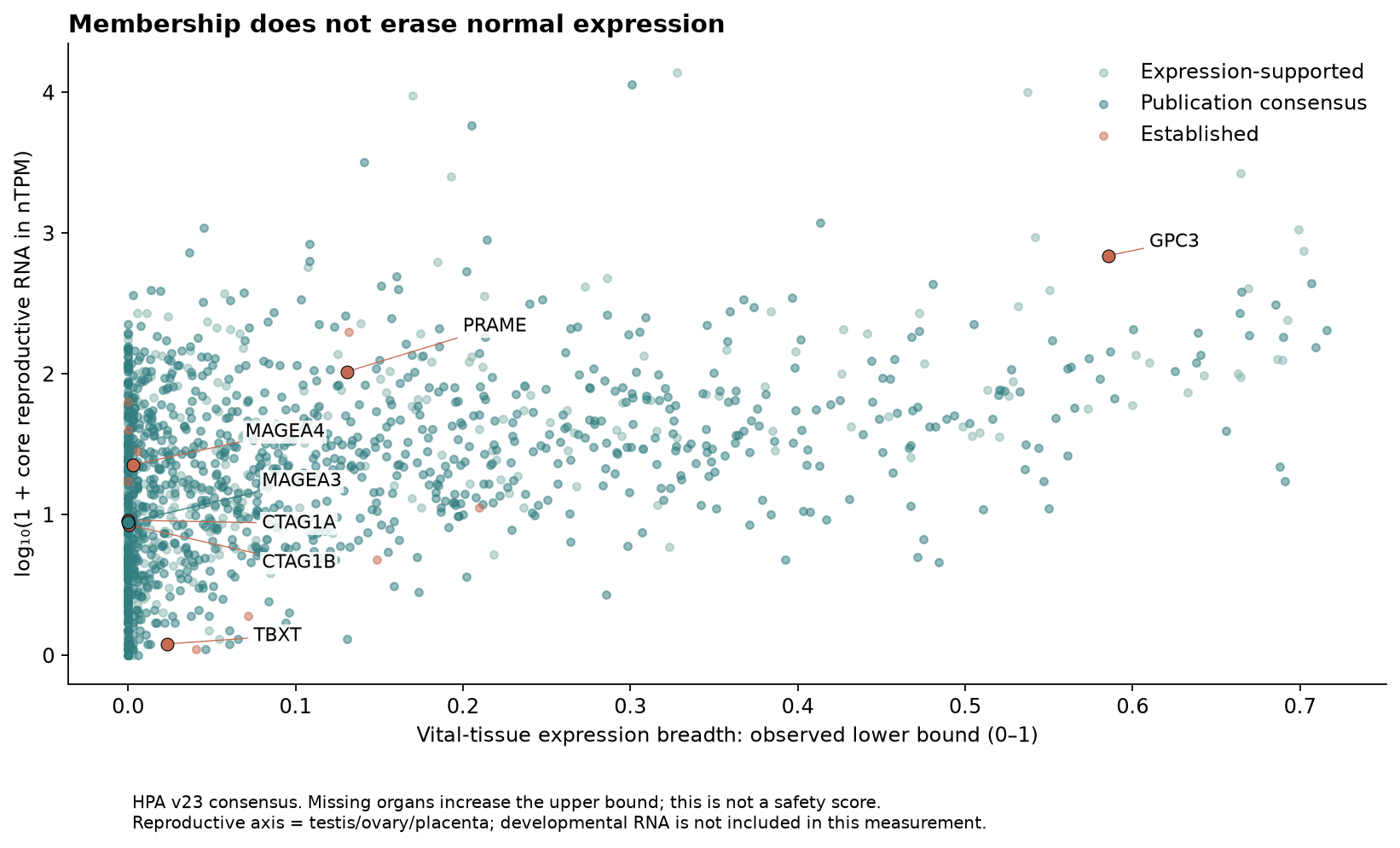
Normal breadth for all 20,097 genes uses the existing
fixed anatomical panel, separate Vital/Protected/Manageable categories, and
RNA / (RNA + category ceiling) contributions. Brain regions share one organ
weight. Missing anatomical weight contributes to an upper bound rather than
disappearing. This is a fixed-baseline descriptive score, not the per-gene
IHC-relaxed score or a new exclusion gate. The earlier breadth report
retains IHC scenarios and donor uncertainty. Only CTAG2 currently has imported
individual-donor evidence; all other genes are labelled unassessed for donors.
Sources, overlaps and scope
Source counts, pairwise overlaps, and gene-level source memberships cover the mapped canonical coding portion of the imported sources. Raw noncoding and unmapped entries remain in the original publication registry. BAGE and GAGE2B remain unresolved identities; the Boel BAGE source has no mapped canonical gene and is absent from the plotted source counts. Distinct papers can reuse GTEx/TCGA or other samples; two publications do not imply two independent biological replications.
Of the original 2,540 nominees, 1,311 are selected and 1,229 are not. The additional 105 selected genes come from the rest of the canonical universe. Nonmembers have no admitting reviewed or publication-consensus route; the disjoint primary reasons for failure of the expression route among the 1,229 original nominees are:
| Primary reason | Genes |
|---|---|
| Reproductive enrichment below 4× in an eligible measured scope | 891 |
| Reproductive RNA below 1 nTPM in an eligible measured scope | 201 |
| No qualifying imported tumor support | 114 |
| Incomplete required RNA coverage | 23 |
For example, SPAG9 and BIRC5 each have only one qualifying paper and fail the enrichment route. WT1, EGFR, ERBB2 and ordinary normal-lineage comparators also fail enrichment with the current inputs. TERT is below the reproductive RNA floor and lacks an admitting curated/consensus record here. These are current evidence-policy outcomes, not assertions that a gene cannot be a tumor antigen or that additional developmental evidence cannot change its membership.
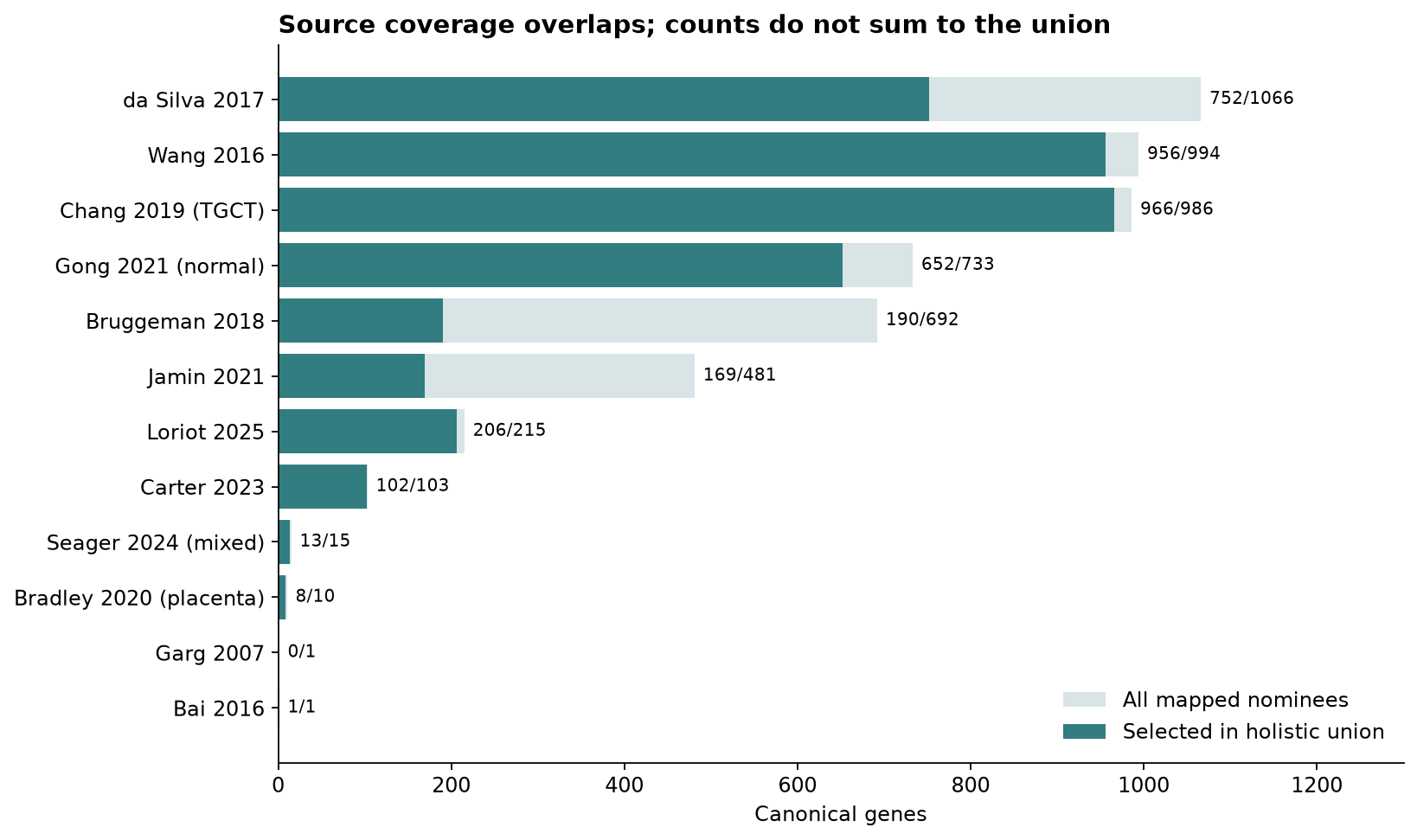
Gong normal-reproductive lists and the da Silva testis-biased-only list supply nomination provenance, not tumor evidence. The Seager mixed panel does not uniformly establish CTA identity. Chang nominations are explicitly TGCT-based. 55 selected genes have only TGCT support in the current positive tumor-RNA summary; this does not rule out additional tumor evidence elsewhere.
Filtering/evidence inputs are HPA v23 normal consensus RNA, HPA v25.1 tumor RNA and IHC summaries, the existing normal protein/literature findings, and the prior cell-RNA/IHC audit. Their source versions and content hashes are in the manifest. The tumor RNA and tumor IHC exports retain patient/sample denominators and cohort identities.
The oncofetal controls are supported by gene-specific studies, including primary papers explicitly describing GPC3 as oncofetal, SALL4 as oncofetal and CLDN6 fetal expression. Gastrulation, organogenesis and DESCARTES atlas measurements are not yet imported. Fetal expression is therefore not included in the ≥1 nTPM reproductive measurement. Developmental admission currently uses reviewed primary evidence; the five oncofetal controls are not an exhaustive oncofetal discovery set. See the developmental-source assessment.
Comprehensive individual primary-paper review remains unfinished (#638). Publication-level intake and control-abstract review must not be represented as full-text assessment of every selected gene. Near-self reference resolution and verified sequence coverage remain separate work (#640/#641).
Sensitivity and reproducibility
All 17 sensitivity scenarios retain every positive control and exclude the seven comparators. Varying the reproductive floor to 0.1/2/5 nTPM gives 1,475/1,391/1,357 genes; changing enrichment to 2×/8× gives 1,737/1,316. Requiring 1/3 publications gives 2,439/1,160. Tumor RNA floors, prevalence, sample counts and IHC-case counts are also varied independently. These are transparent research settings, not fitted clinical cutoffs. Positive controls pass by reviewed evidence, so their recall cannot validate numerical thresholds for unreviewed genes.
from oncoref import cta_membership

genes = cta_membership.gene_ids()  # 1,416
decisions = cta_membership.results()  # 20,097; inspect evidence tier and flags
oncofetal = cta_membership.gene_ids(category="Oncofetal")
Rebuild into an empty directory with
python scripts/build_cta_membership.py --output /tmp/cta-membership-rebuild.
The builder verifies cached source contents, exports the decision facts and
hashes inputs and outputs. --publish additionally updates the packaged table.
Generate figures with python scripts/plot_cta_membership.py <audit-directory>.
The earlier 215/213-gene APIs remain available for historical comparison.