HPA cancer RNA and IHC reference
The genome-wide cancer reference is HPA 25.1, oncoref reference revision v25.1-1, with native Ensembl 109 gene IDs. The HPA cancer download page and release history identify this release. Archived copies of those pages accompany the raw files. Individual file modification dates are not treated as release identifiers. The existing normal-tissue reference remains independently pinned to HPA v23.
| Reference | Scope | Rows |
|---|---|---|
| Cancer IHC | 15,312 genes; 20 cancer groups | 306,237 gene/group rows |
| Cancer RNA | 19,973 genes; 21 TCGA and 10 validation cancer types | 610,303 gene/type/cohort rows |
| Raw sample RNA | 6,918 TCGA + 1,466 validation samples | 166,373,192 gene/sample measurements |
These are the full source gene universes, without a CTA filter. Not every gene has every IHC group or validation RNA cohort. Missing rows are not invented.
API and denominators
import oncoref as od

ihc = od.hpa_cancer_ihc_prevalence()  # all source genes
rna = od.hpa_cancer_rna_prevalence(cohort="TCGA")
comparison = od.hpa_cancer_rna_ihc_comparison(["ENSG00000155622"], threshold=1)
crosswalk = od.hpa_cancer_crosswalk()
cohorts = od.hpa_cancer_rna_cohorts()
sources = od.hpa_cancer_sources()
limitations = od.hpa_cancer_assay_limitations()
Accessors accept one gene ID or an iterable. IDs are not remapped to oncoref's
newer canonical gene space. hpa_gene_name is the IHC source label; RNA-only
genes can have a missing name rather than one guessed from another release.
IHC high, medium, low, and not_detected are scored-patient counts.
total sums them only when all four categories are known. detected sums
high, medium and low; medium_high sums medium and high. Prevalence divides
these counts by a positive total. Missing categories give missing fractions;
zero denominators remain no_scored_patients. Measured zero numerators give
genuine zero fractions. Fractions do not measure stained cells within tumors.
RNA remains in native pTPM, without clean-TPM normalization. samples
counts finite measurements; missing_samples counts explicit missing values;
source_samples counts their union; nominal_samples records source cohort
size. Summaries retain sum_ptpm, mean_ptpm, max_ptpm, and positive counts
and fractions at ≥0.1, ≥1, ≥2 and ≥5 pTPM. Missing measurements are excluded
from denominators. Absent gene/cohort rows are not all-negative observations.
This acquisition has no explicit missing measurements, but absent validation
gene/cohort rows do occur.
TCGA and validation always occupy separate rows. cohort=None returns both
without pooling. The comparison accessor requires one cohort.
Cancer correspondence
The checked-in crosswalk covers all 20 IHC groups and every source RNA code.
| IHC group | Required RNA codes | Treatment |
|---|---|---|
| Colorectal cancer | COAD + READ | Pool sample counts, positive counts and pTPM sums |
| Lung cancer | LUAD + LUSC | Same weighted pooling |
| Renal cancer | KICH + KIRC + KIRP | Same weighted pooling |
| Glioma | GBM only in RNA | scope_mismatch; no comparison RNA values |
| Carcinoid, lymphoma, skin cancer | None | unmatched; no comparison RNA values |
| Remaining 13 IHC groups | One RNA type each | Anatomical correspondence |
Every required RNA type must have measured samples for that gene. Validation
KIRC alone cannot stand in for the renal group. Incomplete pools retain
available/required type counts and incomplete_rna_types, with missing pooled
RNA values. Means are sum(sum_ptpm) / sum(samples) and fractions are
sum(positive_samples) / sum(samples), never unweighted averages of type values.
Anatomical correspondence does not establish identical histologies or patient
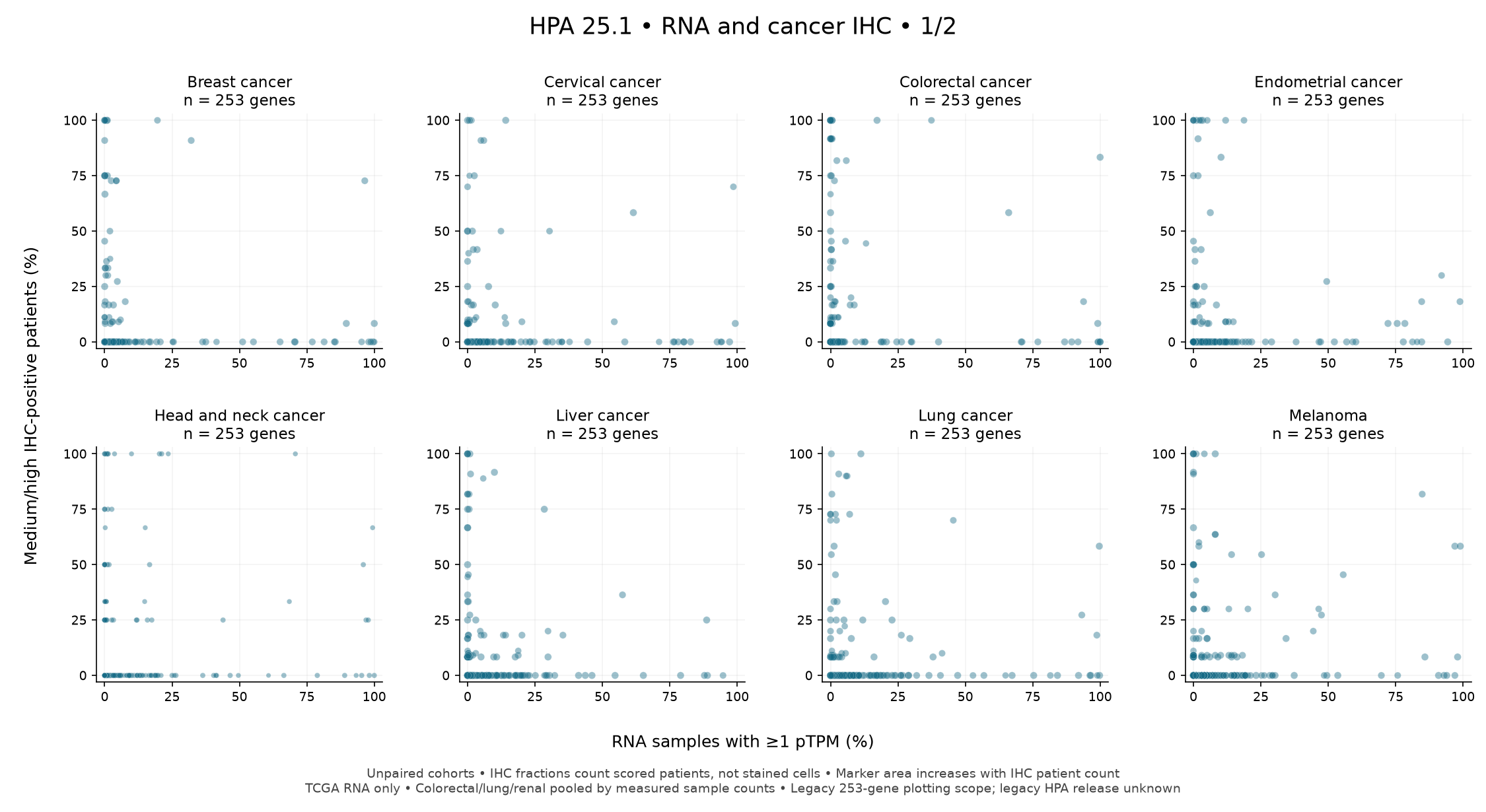
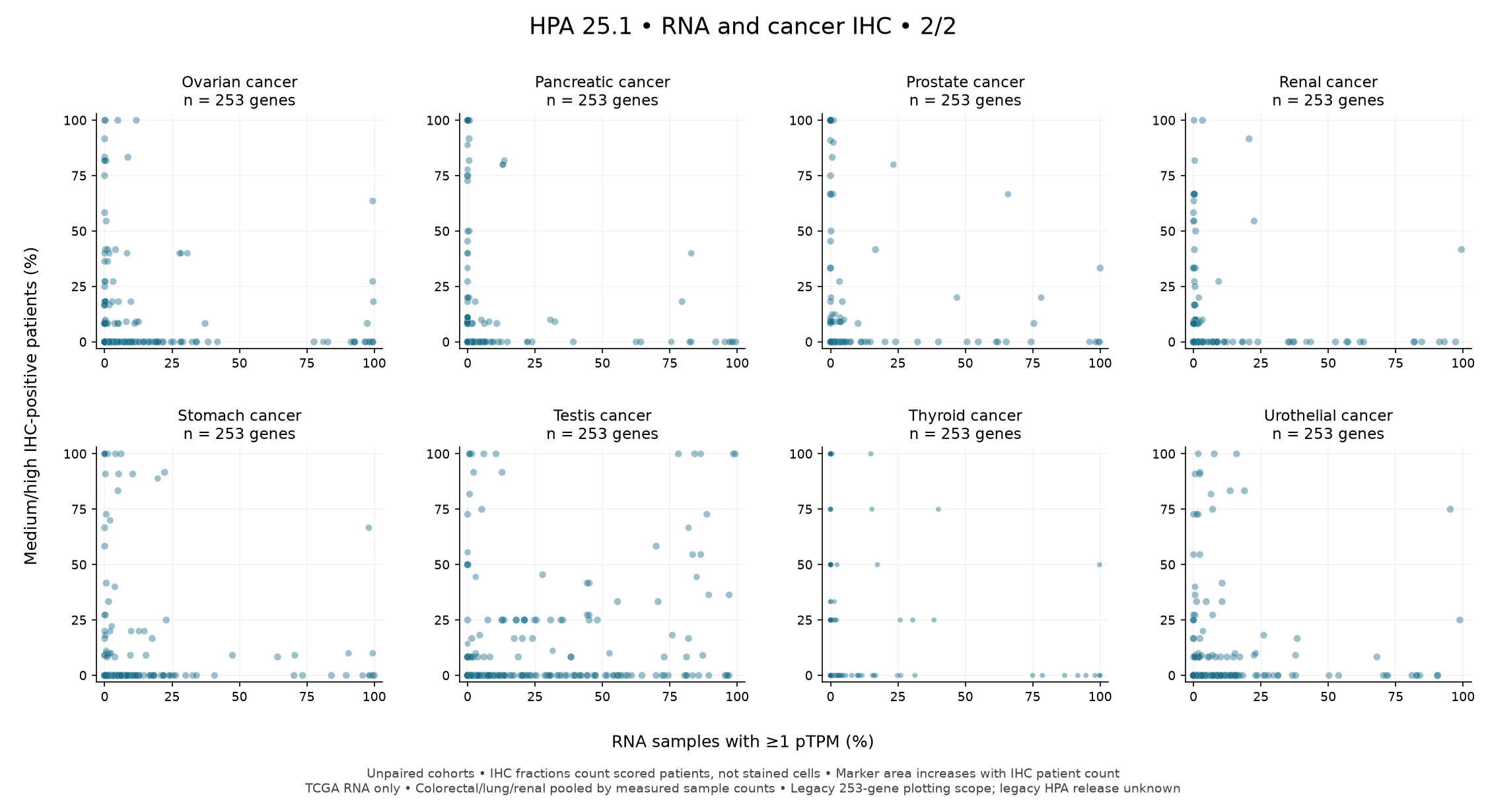
composition. Every comparison has cohorts_paired=False. These descriptive
summaries are not matched RNA/protein calibration or individual-tumor protein
predictions.
Antibody and legacy limitations
The aggregate IHC table has no antibody identifiers or reliability fields. It cannot establish reagent specificity, distinguish paralog cross-reactivity, or adjudicate RNA disagreement. The separate limitations accessor exposes this absence and existing gene-specific normal-tissue curation cautions. Those cautions are not cancer assay revalidation; they neither alter counts nor automatically exclude genes.
The legacy tsarina caches have 5,060 IHC and 10,661 RNA rows. Their HPA release
was not recorded. Their hashes and generator commit remain in
hpa_cancer_sources()["legacy_tsarina"], with hpa_release=None. The fresh
acquisition's 25.1 label is never assigned retrospectively to those caches.
Downloads and reproduction
The archived reference release contains raw downloads, acquisition records, provider release evidence, the derived RNA summary and build audit. Package metadata pins archive and extracted-content hashes. Downloads are checked before atomic promotion; reuse checks the package content pin even for unrecorded cache files. Invalid bytes cannot replace a good cached file.
from oncoref import catalog, reference_data

catalog.ensure("hpa_cancer_ihc")       # small raw IHC table
catalog.ensure("hpa_cancer_rna")       # precomputed RNA summary
reference_data.verify("hpa_cancer_rna")
# Optional reproduction input, not needed by the prevalence APIs:
catalog.ensure("hpa_cancer_rna_samples")  # approximately 1.36 GB; stays gzipped
Caches use CANCERDATA_DATA_DIR/sources or ~/.cache/oncoref/sources, with
independent source/version directories. oncoref data fetch hpa includes the
large sample input; the prevalence APIs only fetch their compact references.
Download the seven files named in hpa_cancer_sources()["raw_sources"] from
their archive_url into a source directory. Then run:
python scripts/build_hpa_cancer_reference.py \
  --sources /path/to/hpa-cancer-sources --output /path/to/rebuild
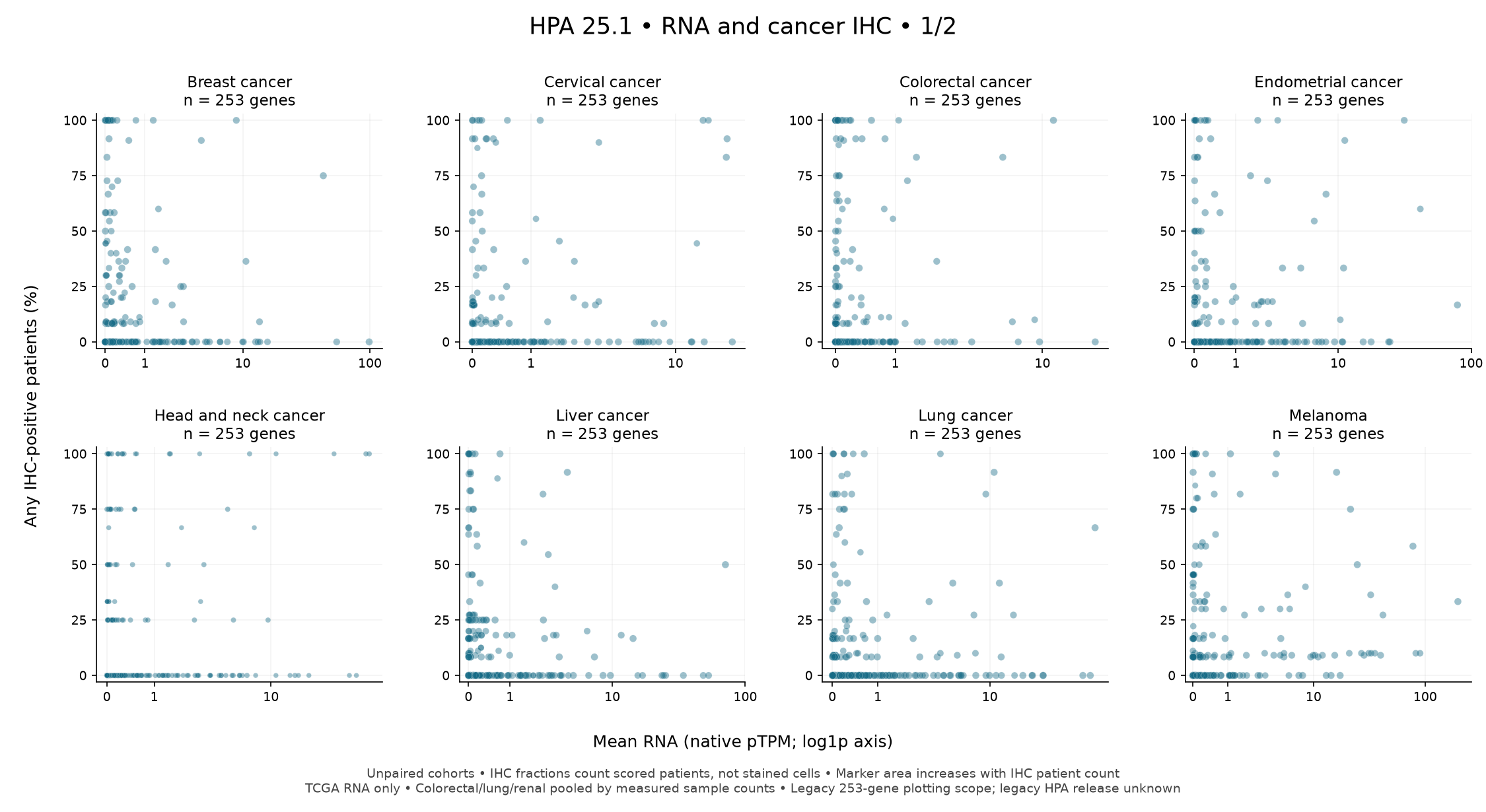
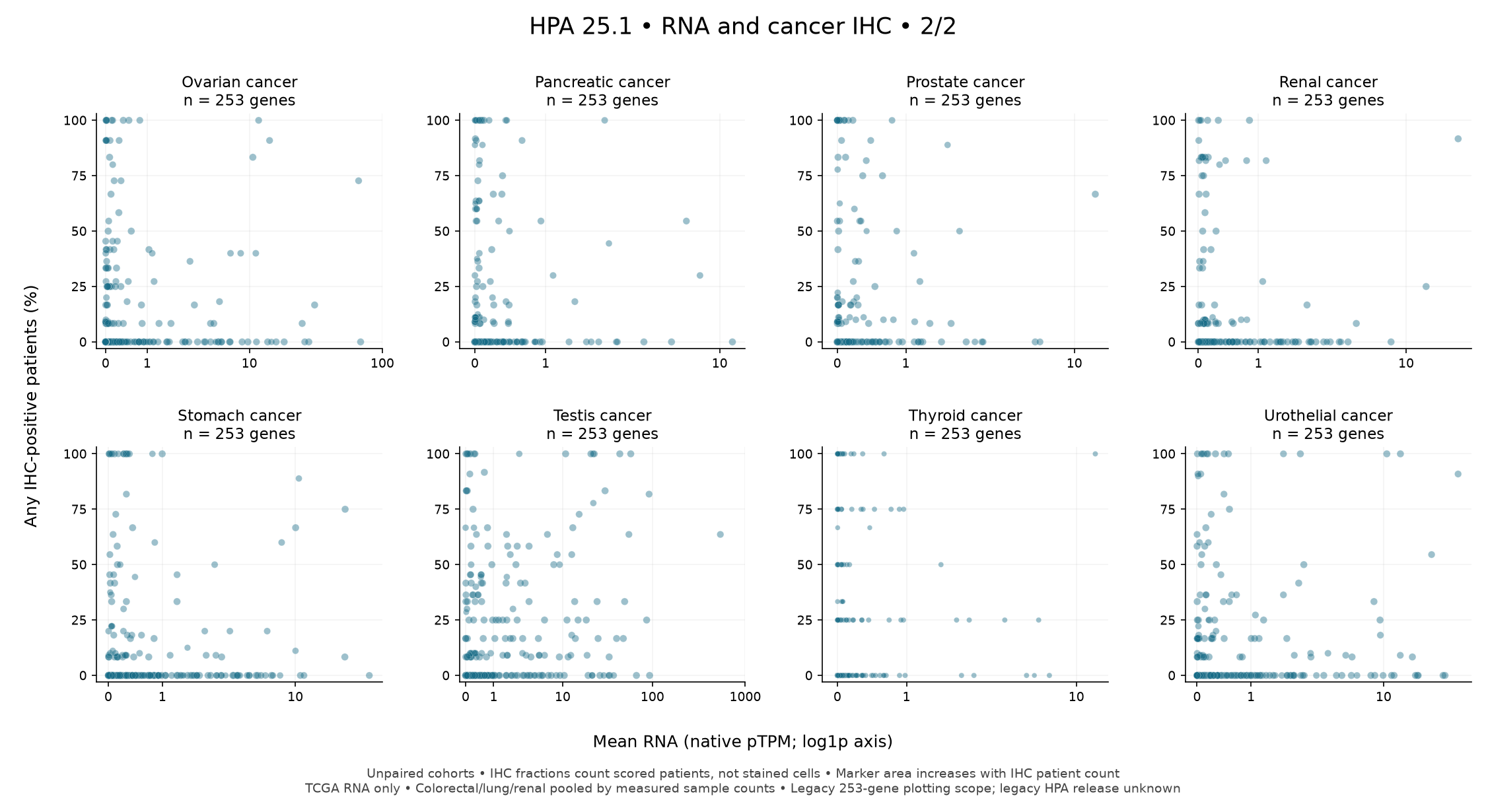
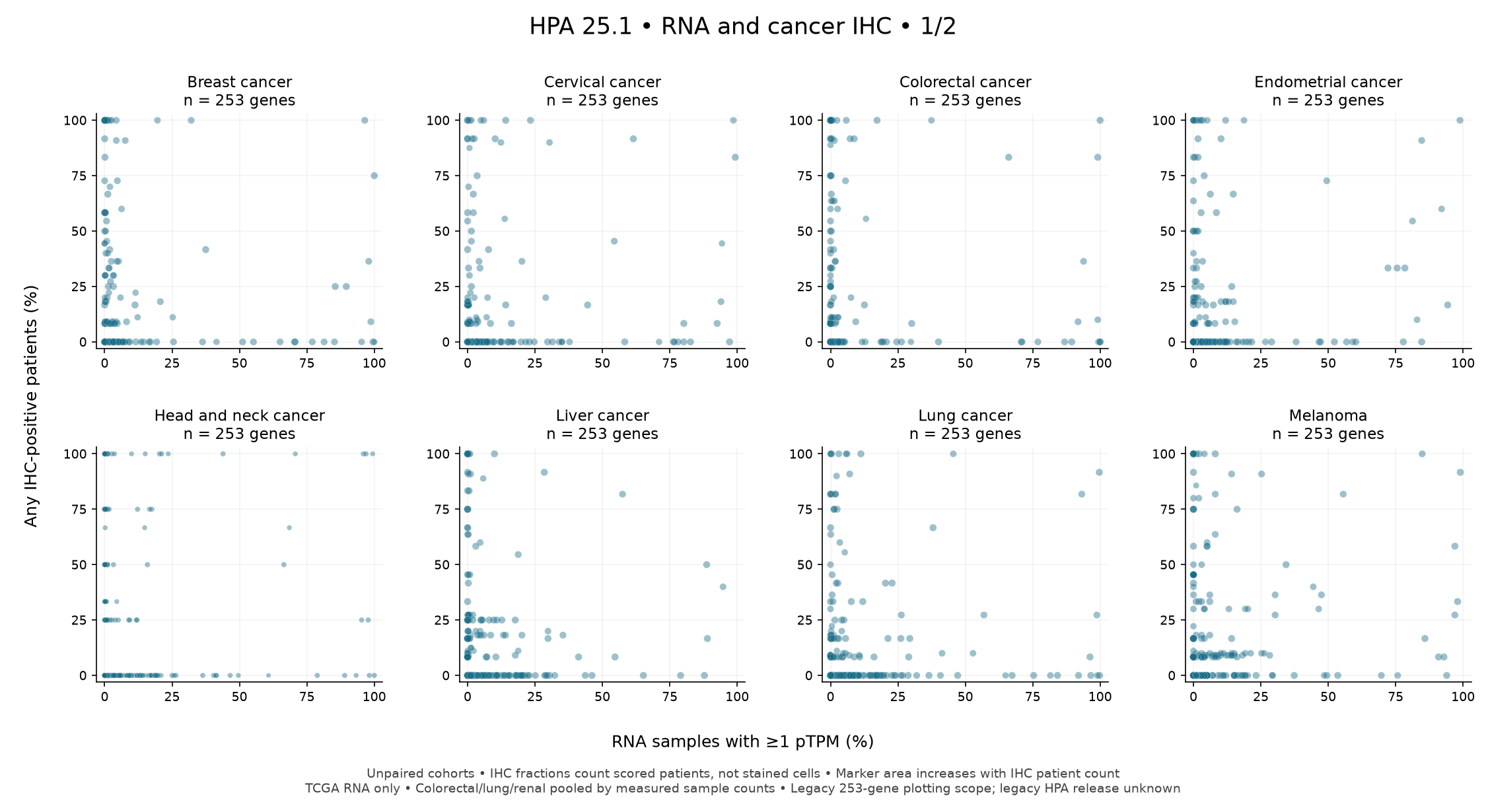
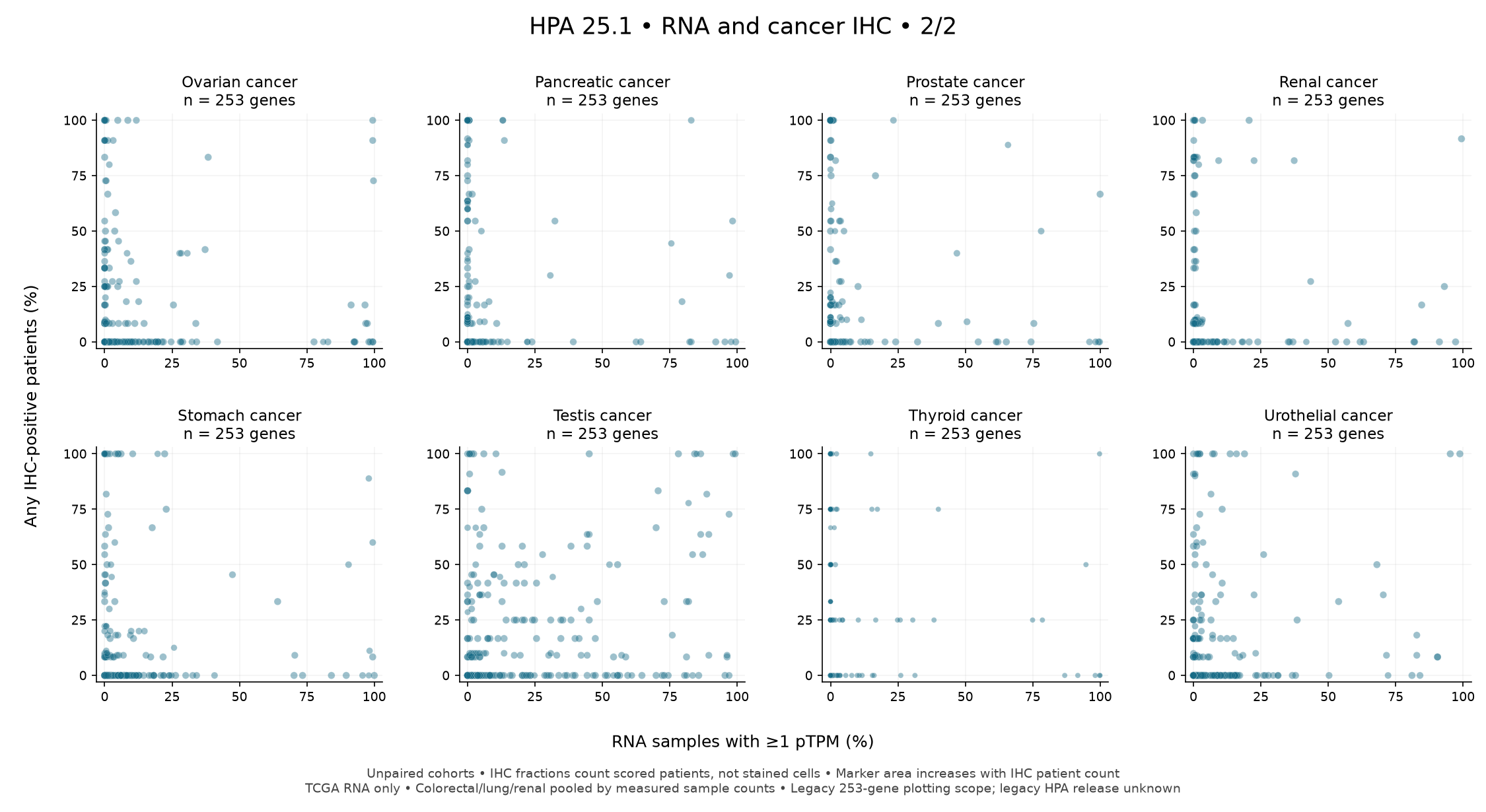
python scripts/plot_hpa_cancer_comparison.py
The builder verifies raw hashes, processes complete contiguous gene blocks in bounded memory, and rejects duplicate identities across parser chunks and negative/nonfinite nonmissing measurements. ZIP metadata is fixed. Derived hashes are recorded in the package source manifest and build audit.
The validation audit checks genome-wide denominators, identities and comparison outcomes. The archive audit verifies all 17 uploaded assets against their server-side SHA-256 digests. Both runtime references were also downloaded into an empty cache and used from a built wheel.
The plots preserve the checked-in legacy 253-gene plotting scope while the reference remains genome-wide. They contain 4,048 comparable gene/group rows, 253 glioma scope mismatches and 759 unmatched rows. The plot audit and comparison table retain those outcomes.
Migrating tsarina after release
After oncoref 1.8.201 ships, replace tsarina's cached CSV loaders and generator
with these accessors. Its candidate-selection functions must explicitly select
their intended gene IDs because the new defaults are genome-wide. Join current
curated symbols by gene ID downstream; hpa_gene_name is a source annotation.
Existing IHC count/prevalence names and RNA threshold/count names are preserved; new fields expose denominators and source cohorts. Use the comparison API in place of an ad hoc crosswalk. Keep legacy cache hashes as historical provenance. Downstream cache ownership moves in the follow-up migration after the oncoref release is available.
Retaining RNA-only genes in focused profiles
hpa_cancer_rna_ihc_comparison(..., include_missing_ihc=True) retains genes
observed in either selected assay across all 20 IHC groups. This opt-in mode
preserves the default IHC-indexed output for existing callers. IDs absent from
both assays are not invented.
For example, INSL4 (ENSG00000120211) has RNA in all 21 TCGA and 10 validation
cohorts in HPA 25.1, but has no aggregate cancer IHC row. The opt-in output
keeps its valid pooled RNA summaries and marks IHC counts/fractions missing;
measurement_status=missing_ihc records that absence. If RNA and the crosswalk
otherwise allow a comparison, comparison_status=missing_ihc; scope mismatches,
unmatched groups and incomplete RNA pools retain their more specific statuses.
These two status columns are independent, so a missing IHC assay is still
visible on a glioma scope-mismatch row. Unknown protein staining is never zero.
This records a source coverage gap, not a negative protein result. INSL4 protein validation must be separately sourced; no inference from RNA supplies it.