Bradley cancer-placenta candidates: normal-tissue gate audit
Bradley et al. 2020 provides a cancer-placenta nomination list and HLA-A*01:01 peptide/T-cell evidence for VGLL1. Oncoref's default answers a separate question: whether current normal-tissue RNA/IHC meets the reproductive-restriction and specificity rules.
Results
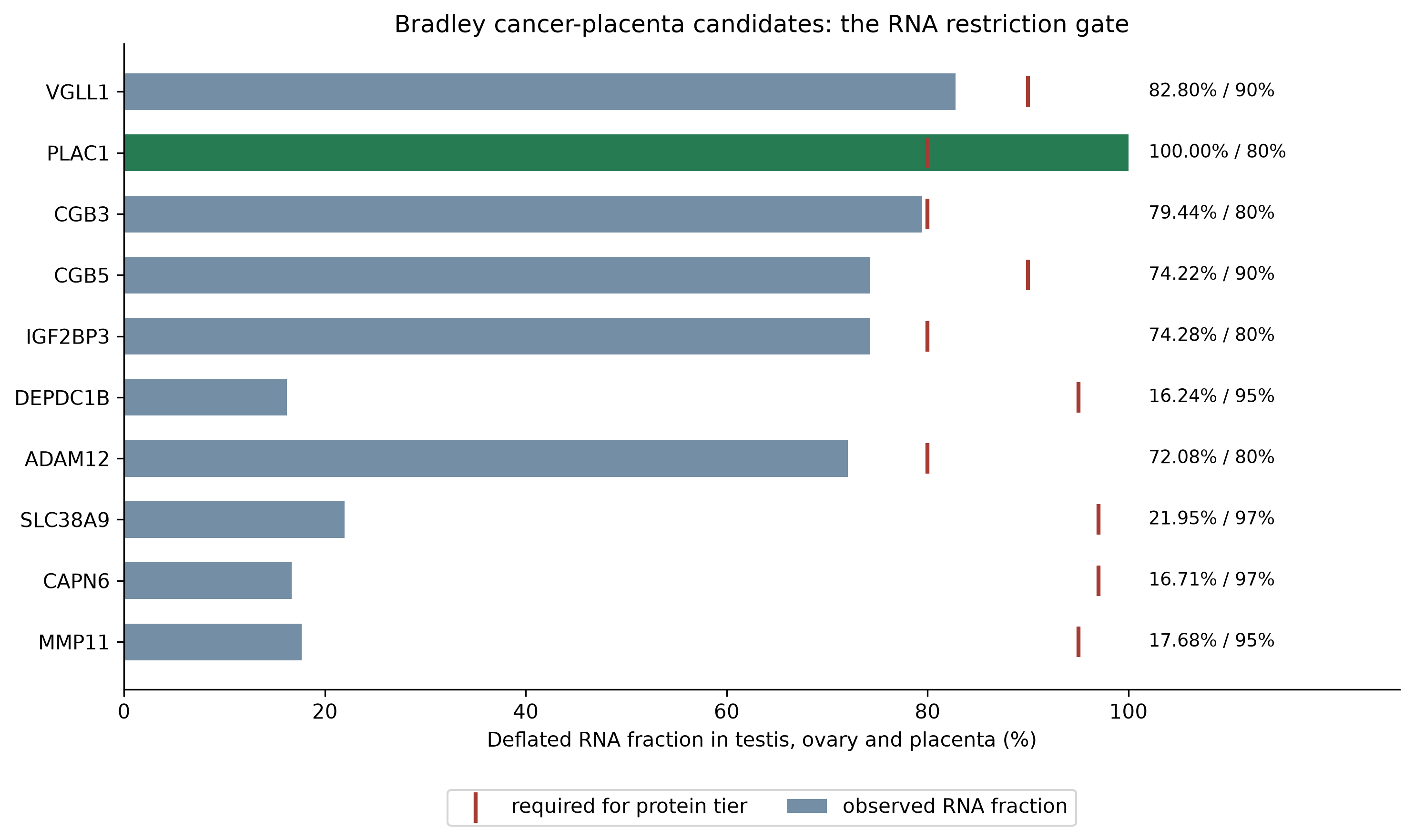
| Gene | HPA deflated RNA fraction | Required | IHC restriction gate | Default |
|---|---|---|---|---|
| VGLL1 | 82.80% | 90% | Pass | Excluded |
| PLAC1 | 100.00% | 80% | Pass | Retained |
| CGB3 | 79.44% | 80% | Pass | Excluded |
| CGB5 | 74.22% | 90% | Pass | Excluded |
| IGF2BP3 | 74.28% | 80% | Fail | Excluded |
| DEPDC1B | 16.24% | 95% | Fail | Excluded |
| ADAM12 | 72.08% | 80% | Pass | Excluded |
| SLC38A9 | 21.95% | 97% | Fail | Excluded |
| CAPN6 | 16.71% | 97% | No IHC; no veto | Excluded |
| MMP11 | 17.68% | 95% | Fail | Excluded |
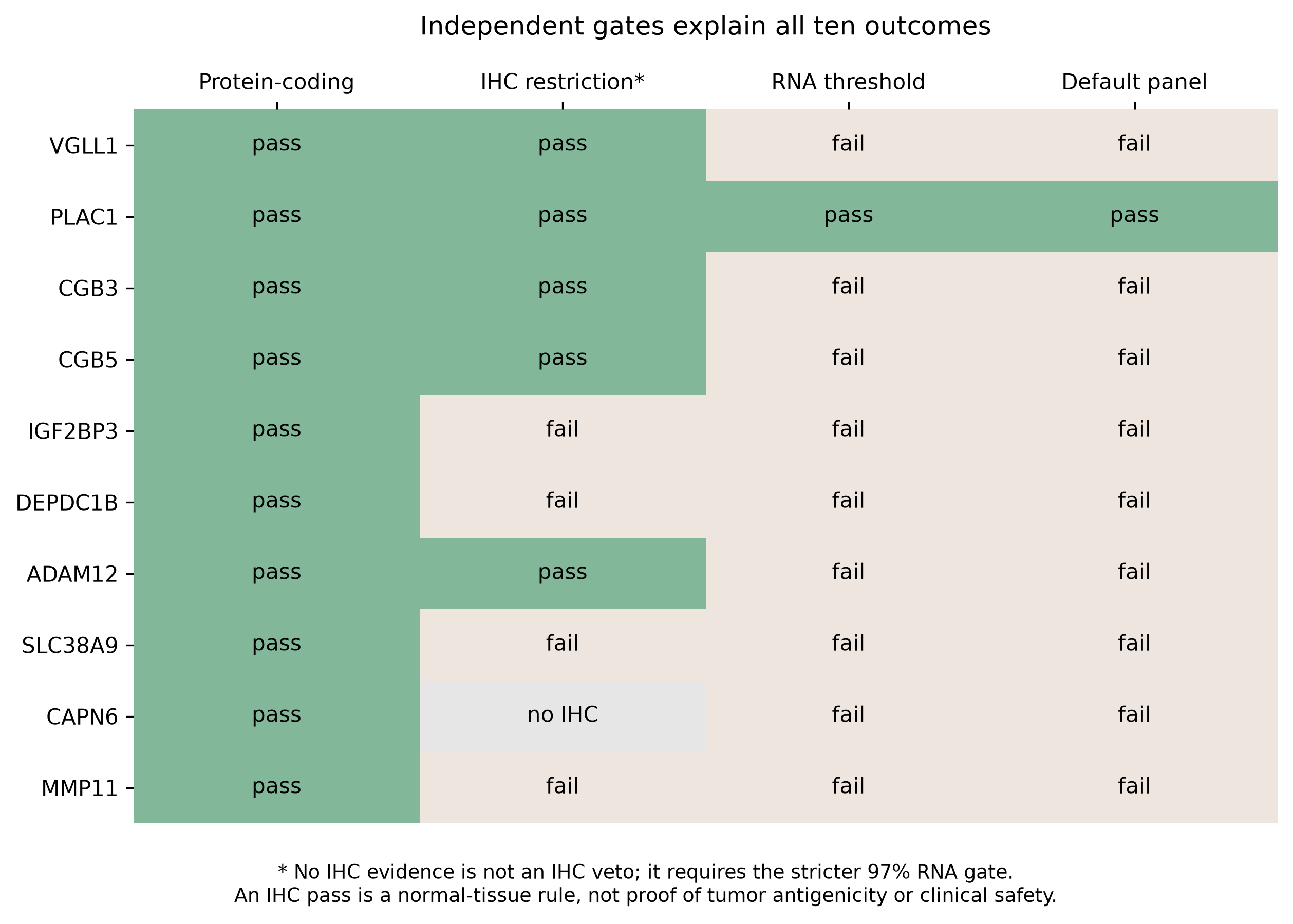
All nine exclusions fail the RNA gate. Four additionally fail IHC restriction. CAPN6 has no IHC evidence, so the stricter missing-protein RNA threshold applies. The matrix marks that cell as grey “no IHC”, separately from a measured IHC pass. No Bradley candidate is removed only by the later default specificity step. No thresholds or candidate membership were changed by this audit.
Why VGLL1 remains a candidate
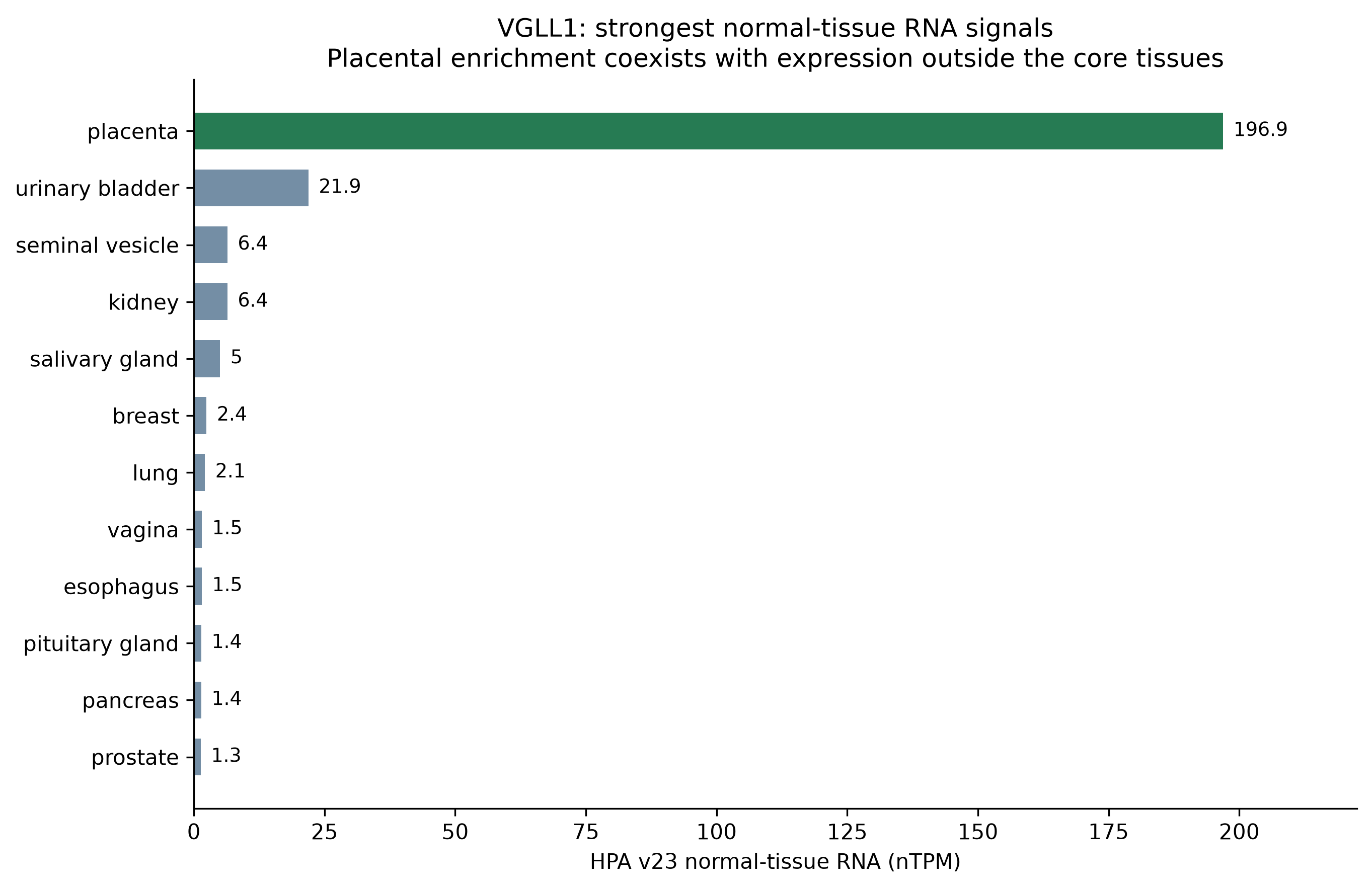
VGLL1 has Supported normal-tissue IHC reliability and passes the IHC tissue rule, but its 0.8280 deflated RNA fraction fails the required 0.90. HPA v23 has placenta RNA at 196.9 nTPM and urinary bladder at 21.9 nTPM, with further expression outside the three core tissues. These are HPA consensus nTPM values, not the paper's GTEx TPM values; their numbers should not be interchanged.
The paper divides normal tissues by risk category and experimentally tests primary cells. Its Figure 6 reports recognition of primary mammary cells and low bladder-cell recognition at the highest effector:target ratio, alongside lack of recognition in the tested lung-airway cells. This supports recording VGLL1 tumor antigenicity while retaining the normal-tissue caveat. It does not establish clinical safety across all tissues or patients.
Tissue scopes and the display correction
The deflated RNA numerator uses testis, ovary and placenta; thymus is omitted
from the denominator. The IHC allowed-tissue rule and the rna_max_somatic_*
annotation use broader reproductive-tissue scopes, including accessory tissues
and breast. They are not interchangeable with that RNA numerator. The maximum
somatic field therefore does not enumerate every contributor to RNA-gate
failure. The exported full normal-tissue observations make those contributors
reviewable. Antibody reliability is not evidence that every paralog is resolved.
The audit found a figure-label bug: curation plots had displayed 98% for
Uncertain/missing protein, while HPA_ADAPTIVE_PROTEIN_RNA_THRESHOLDS and the
actual filter use 97%. Plot thresholds now derive from that owner constant;
regression tests require agreement. This corrects the display without relaxing
the filter.
Reproduction and machine-readable evidence
oncoref.cta_gate_audit.cta_gate_audit() explains every candidate and verifies
that the conjunction reproduces the stored HPA gate. bradley_candidate_audit()
selects the ten published genes. Run:
python scripts/plot_cta_bradley_audit.py --out docs/audits/cta-bradley
The report writes independent gate flags/reasons, complete HPA v23 normal RNA and IHC observations for these genes, input SHA-256 hashes, and 300 dpi PNGs with vector PDF siblings. Cancer-IHC patient fractions are a separate HPA 25.1 reference and are not used to make these normal-tissue restriction calls.